How to Choose the Right Property Survey in South London

One of the most common questions we receive from buyers across South London is: "Which survey do I actually need?" It's a fair question — the UK property survey market has three distinct RICS-recognised levels, plus valuations, specialist surveys and snagging inspections. For a first-time buyer or anyone who hasn't purchased in a while, it can be genuinely confusing. As local chartered surveyors in Brixton, we've helped thousands of buyers navigate this — here's our plain-English guide.
The Three RICS Survey Levels Explained
Since 2021, RICS has standardised residential survey products into three levels. Each builds upon the previous in depth and scope.
RICS Level 1: Condition Report
The most basic survey available. It provides a brief, traffic-light condition rating (green, amber, red) for each part of the property but no detailed commentary, no advice and no valuation. It's designed for new-build properties or very recently renovated homes in excellent condition that you already know well. For most South London buyers purchasing Victorian or Edwardian stock, a Level 1 is simply not sufficient.
Best for: New-build properties or modern (post-2000) properties in excellent condition
Typical cost: £250–£350
RICS Level 2: HomeBuyer Survey
The UK's most popular residential survey, the Level 2 HomeBuyer Survey is a detailed inspection of the property's visible and accessible elements. Your surveyor will work through every room, recording condition ratings and providing commentary on significant defects, maintenance items and legal risks. An optional valuation can be added.
It's a comprehensive report — typically 30–50 pages — but it has limitations. Floors cannot be lifted, roof spaces are inspected only where accessible, and the surveyor reports on what's visible, not what might be hidden. On a straightforward, well-maintained property, this is entirely adequate.
Best for: Conventional properties built after 1920, in reasonable condition, where the buyer is not planning major structural alterations
Typical cost: £400–£650 (South London)
RICS Level 3: Building Survey
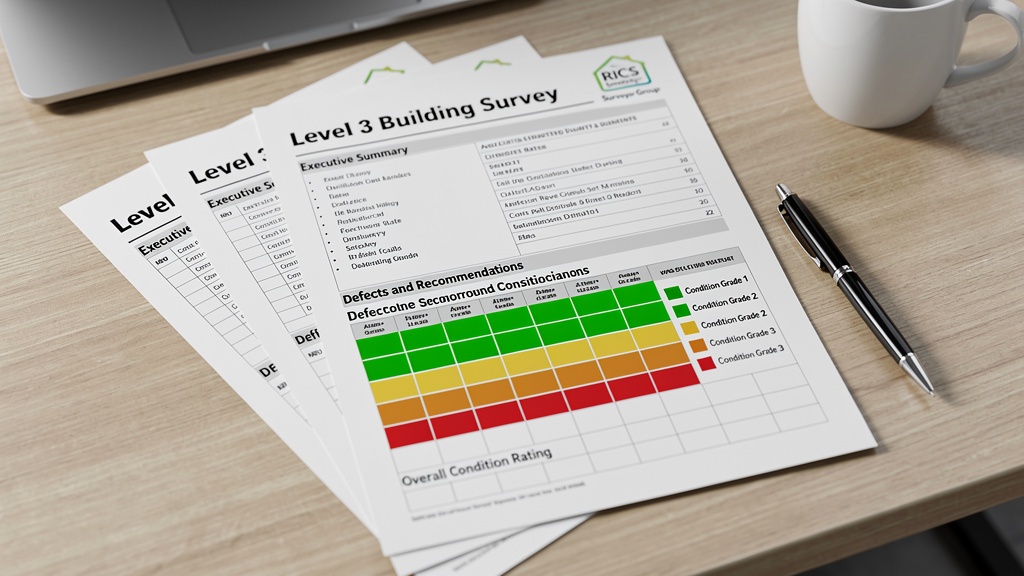
Formerly called the "Full Structural Survey," the Level 3 is the most comprehensive residential survey available. Your surveyor provides a detailed assessment of the structure and fabric of the property, including commentary on how defects may have occurred, the risk of hidden defects, and specific advice on remediation. Typical reports run 60–100 pages. Costs are higher, but the investment is typically small relative to the potential saving.
For Brixton Victorian terraces — which routinely have issues with drainage, masonry, damp, timber decay and roof structures — a Level 3 is very often the right choice.
Best for: Victorian and Edwardian properties, period conversions, listed buildings, properties in poor condition, any property where significant renovation is planned
Typical cost: £600–£1,200 (South London, depending on size)
The Quick-Reference Decision Guide
Use this guide as a starting point — and always discuss your specific property with your surveyor before confirming which level is appropriate.
| Property Type | Recommended Survey | Reason |
|---|---|---|
| New-build (completion within 10 years) | Snagging Survey | Warranty period applies; NHBC covers structural issues |
| Post-1990 house in good condition | Level 2 | Modern construction, standard materials, low risk of hidden defects |
| 1930s–1980s semi or terrace | Level 2 or Level 3 | Depends on condition; consider Level 3 if significant work visible |
| Victorian / Edwardian terrace (pre-1919) | Level 3 | Age, construction type and likely defect complexity warrants full survey |
| Listed building or unusual construction | Level 3 + Specialist reports | Specialist knowledge required; standard survey may not be adequate |
| Leasehold flat (any age) | Level 2 + Lease review | Lease terms as important as building condition; check remaining term |
| Property for major renovation | Level 3 | Full understanding of structure needed before planning works |
What About a Mortgage Valuation?
Your mortgage lender will instruct their own surveyor to carry out a mortgage valuation. This is not a survey — it is an assessment for the lender's purposes to confirm the property is worth the purchase price. The valuation report typically runs to one or two pages and is produced for the lender, not for you.
Many buyers make the mistake of assuming a mortgage valuation means the property has been checked for defects. It hasn't. The mortgage valuation won't identify rising damp behind the front room fireplace, defective drainage or a roof nearing the end of its serviceable life. Commissioning your own independent survey is entirely separate from the lender's valuation.
Do I Need a Specialist Survey as Well?
In some cases, a standard RICS survey will identify issues that require a specialist's input. The most common specialist surveys your surveyor might recommend include:
- Structural engineer's report: For significant cracking, subsidence concerns or major structural alterations
- Drainage CCTV survey: For older properties in Brixton, drainage defects are common. A CCTV survey costs £150–£300 and can reveal collapsed drains, root intrusion or shared drainage arrangements
- Electrical installation condition report (EICR): Essential if the electrics appear dated (fuse board rather than consumer unit, older wiring)
- Gas safety inspection: For any property with a gas supply, a Gas Safe engineer should confirm the system is safe
- Japanese knotweed survey: Relevant if the property is near railway lines, river banks or previously undeveloped land in South London
- Asbestos survey: Required for properties built before 1985, particularly if renovation is planned
How to Choose a Surveyor
With any survey, the qualification and local knowledge of the surveyor matters as much as the survey type. Look for:
- RICS membership — look for MRICS or FRICS after their name
- Local experience — a surveyor who regularly works in Brixton and South London will have much better contextual knowledge of local construction types, drainage systems and planning history than someone parachuted in from a national firm
- Independence — avoid surveyors who are recommended by or connected to the selling estate agent
- Clear communication — a good surveyor explains their findings in plain English, not just condition ratings
Not Sure Which Survey You Need?
Call us and we'll give you honest, free advice on which survey is right for your specific property — no obligation, no sales pressure.
Speak to a SurveyorThe Most Common Mistake Buyers Make
Every week we speak to buyers who chose a Level 2 survey on a Victorian Brixton terrace to save £200–300 — and ended up with a report that couldn't tell them about the condition of the chimney stack, the likely state of the original drainage, or the pattern of cracking visible in the rear outrigger. When they found these issues after exchange, they had no expert baseline to refer back to and no leverage to renegotiate.
The survey cost is a tiny fraction of the property purchase price. Spending an extra few hundred pounds to get the right level of survey is almost always worth it.
